





-
KT300
-
KENT
-
Bubble Pouches
-
PE Bubble Film

KENT Bubble Pouches, also known as bubble wrap pouches, provide cushioning and surface protection in a preformed bag format. Simplify repeat packing of similarly sized items without cutting and wrapping individual sheets. Send your product dimensions, closure requirements and quantity for a quotation.
Request a Custom Quote
Bubble Pouch Structure and Packing Benefits
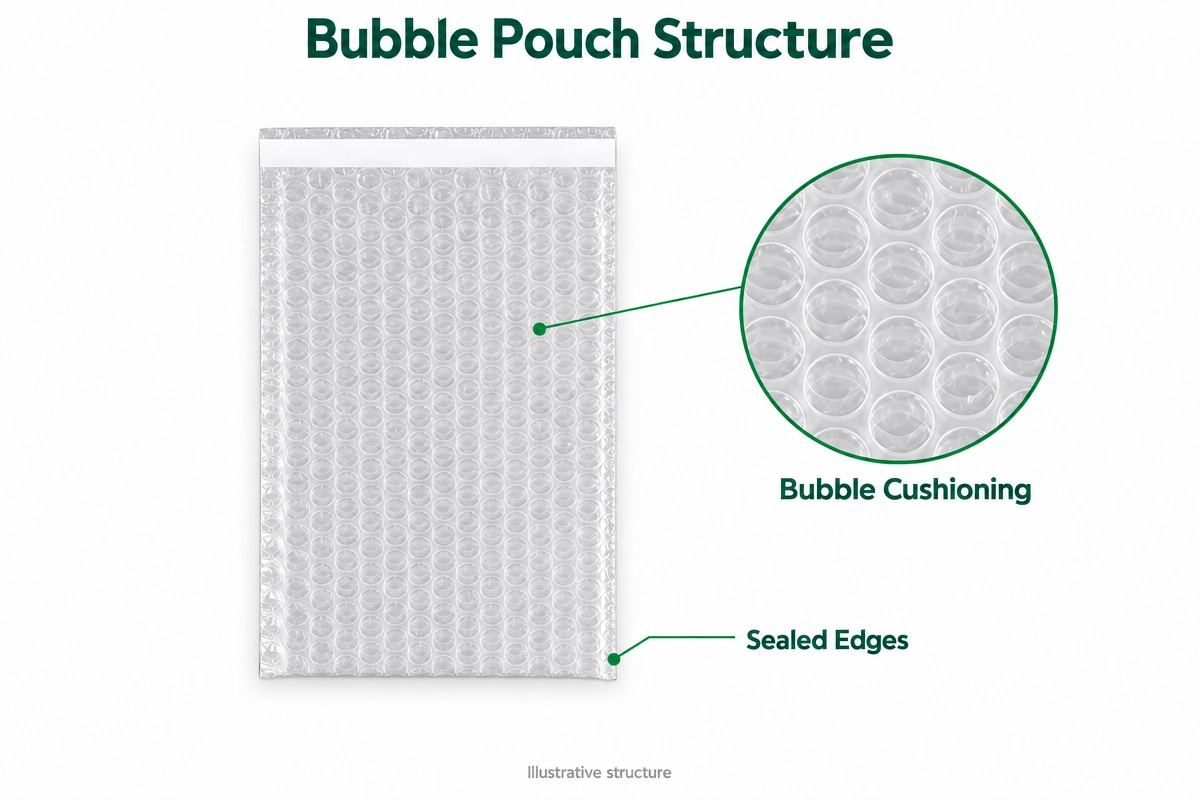
Bubble Cushioning and Sealed Edges
The pouch surrounds your product with flexible bubble cushioning, while sealed edges form the loading space. Transparent material helps you identify contents and check items before closing the outer carton.
Assess the construction, seams and loaded fit together. A suitable pouch should allow easy insertion, limit unnecessary movement and avoid continuous strain on the seams.
Do the Bubbles Face Inward or Outward?
Bubble out bags generally have raised bubbles facing outward, with a comparatively flat inner contact surface. Other pouch constructions may differ. The term “bubble pouches” alone does not identify bubble orientation or wall construction.
Confirm the inner and outer surfaces, bubble direction and layer structure. For polished, coated or easily marked products, check direct-contact suitability and add a soft interleaving layer where needed.
How Do Preformed Pouches Simplify Packing?
Preformed pouches remove the need to cut Bubble Film and wrap each item individually. They are useful for repeated packing of similarly sized products.
Select the size, insert the item, close or secure the opening as required, and place it in suitable outer packaging. The preformed pouches described here do not require an inflation machine before use.
Self-Seal vs. Open-End Bubble Pouches
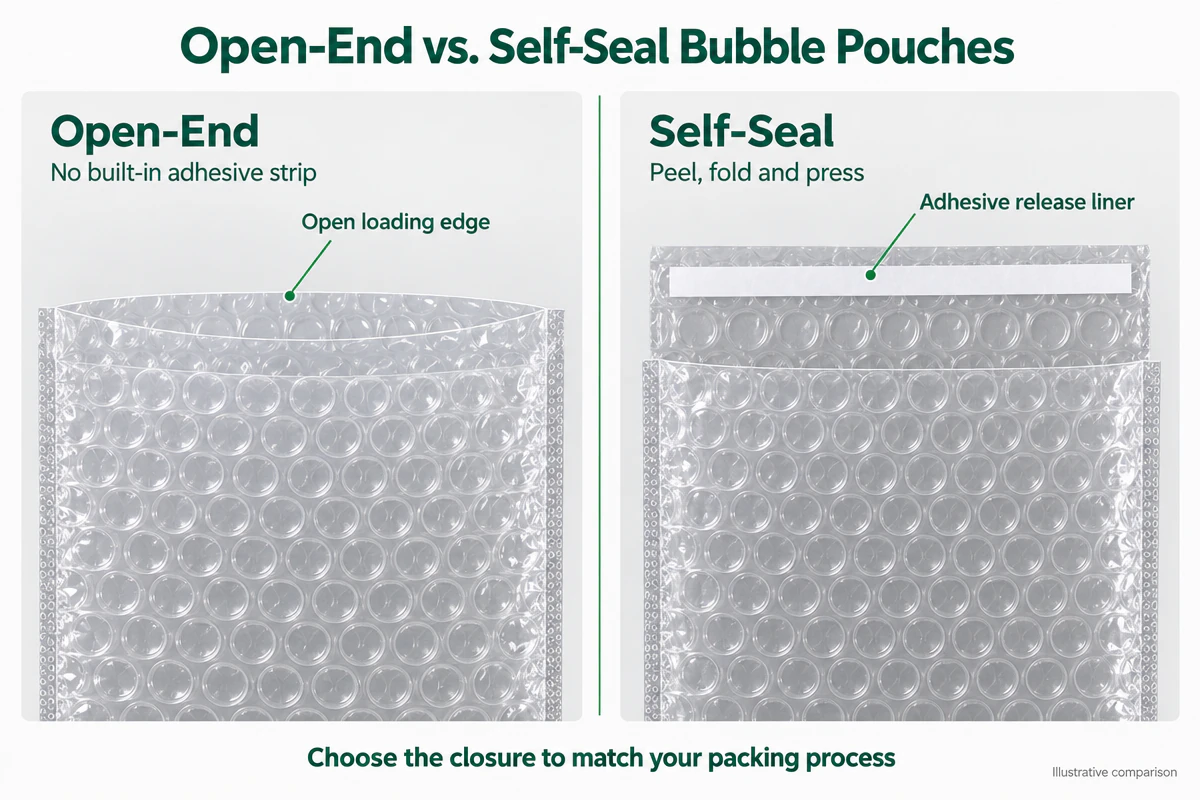
The main differences concern closure, product retention and access. Use the comparison below to identify your requirements; confirm available formats against the order specification.
Consideration | Open-End Bubble Pouches | Self-Seal Bubble Pouches |
|---|---|---|
Opening | No self-seal closure | Adhesive area closes the opening |
Packing steps | Insert the item and secure it where needed | Insert the item, remove the release liner and press the closure |
Suitable workflow | Easy access or product retention provided by cartons and dividers | Closing the opening with fewer separate taping steps |
Selection priority | Risk of the item sliding out and need for additional retention | Closure space, adhesive handling and closing performance |
Reuse | Assess pouch and bubble condition | Also assess whether the closure remains usable |
Open-End Bubble Pouches
Open-end pouches suit easy loading and removal, such as handling between production stages, separating items or providing individual protection before carton packing.
If the product could slide out, add suitable retention rather than relying on the pouch alone.
Self-Seal Bubble Pouches
Self-seal bubble pouches suit packing processes that require a closed opening to help retain the item. Leave enough closure space after loading instead of stretching the pouch to force it shut.
Self-seal does not necessarily mean reclosable. State any return-packaging or repeated-access requirements when requesting a quotation.
Bubble Pouch Sizes and Specifications
How Can You Check Product Fit?
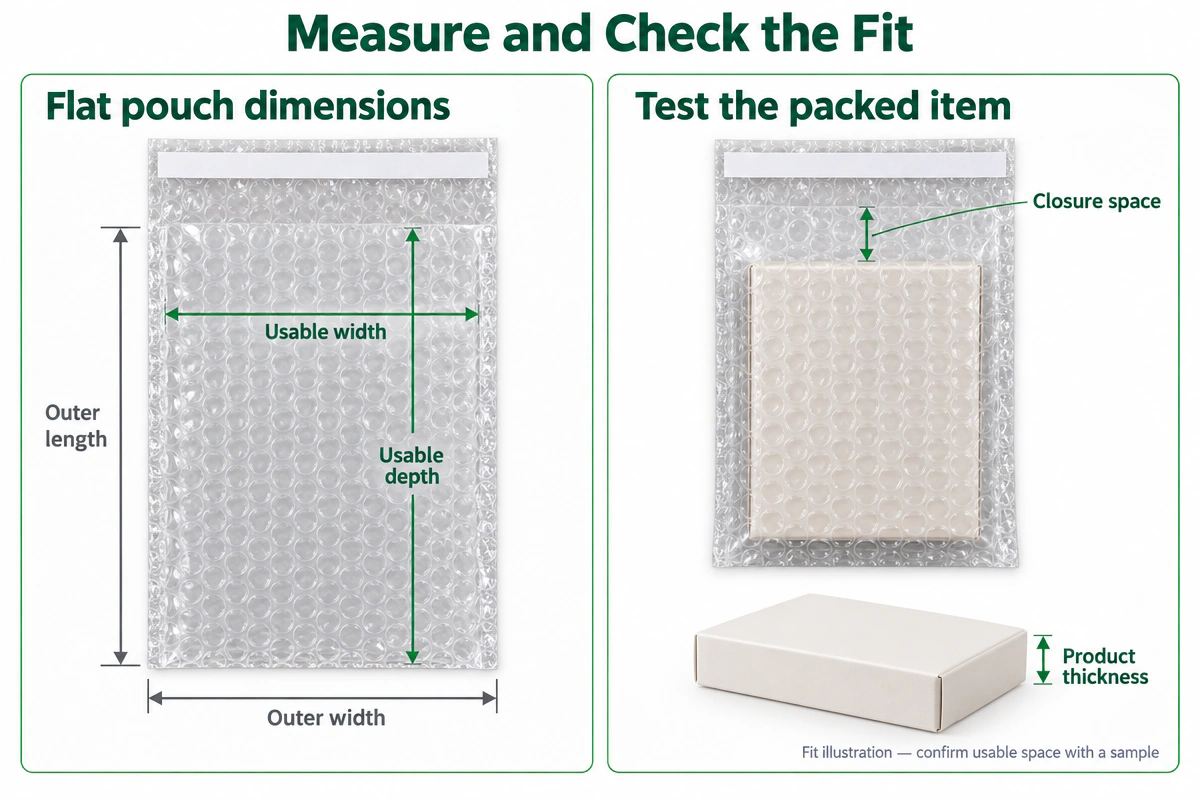
Start with your product’s length, width, thickness and weight, then check usable internal pouch dimensions. Flat external measurements do not describe the available loading space: seams, cushioning and product thickness all affect fit.
Check the opening, body and closure area. Products should load easily without excessive stretching, leaving sufficient room to close the pouch. Test actual items with handles, protrusions or irregular edges.
Specification | Details to Confirm |
|---|---|
Pouch dimensions | External size and usable internal width and length |
Opening and closure | Opening style, closure length and repeated-access requirements |
Material and wall construction | Material composition, layers, bubble orientation and inner surface |
Cushioning | Bubble diameter, bubble height and film thickness |
Packing quantity | Pieces per pack and per carton |
Shipping pack | Carton dimensions, gross weight and label content |
Choosing Bubble Size and Film Thickness
Bubble diameter, bubble height and film thickness are separate measurements. One “thickness” value cannot describe them all.
Select the construction around product weight, surface sensitivity, edge shape and shipping conditions. Larger-looking bubbles or thicker film alone do not establish adequate protection. Evaluate the actual product inside the intended complete package.
Packing Quantity and Shipping Volume
For wholesale bubble pouches, compare unit price, carton quantity, carton dimensions and gross weight. A lower unit price does not necessarily mean a lower delivered cost.
Use consistent dimensions, material, closure and packing requirements when comparing quotations.
Applications and Protection Requirements for Bubble Wrap Pouches
Glassware, Ceramics and Small Fragile Items
Bubble wrap pouches provide individual cushioning for small glass items and ceramic ornaments, helping separate products packed together.
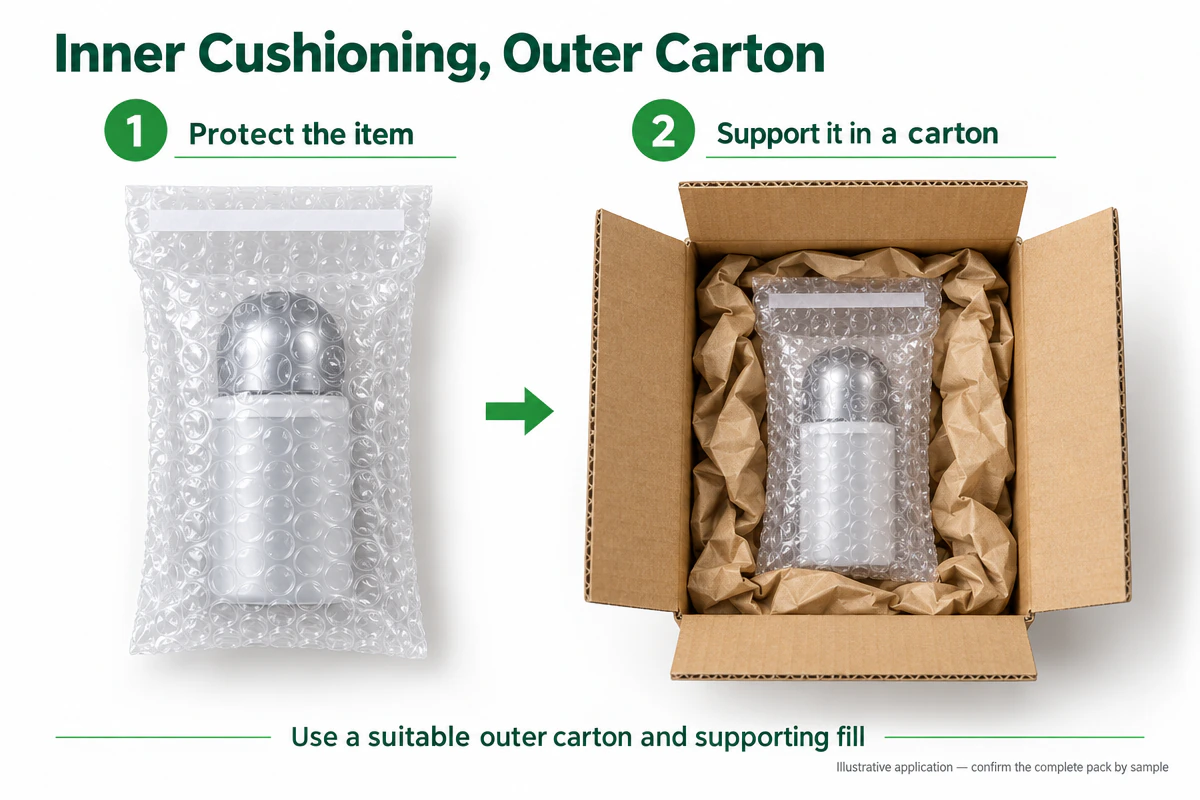
Handles, necks and protruding areas need particular attention. Fragile shipments may also require suitable cartons, dividers and void fill; the pouch should not be the only protection considered.
Beauty Products, Jewelry and Gift Accessories
Pouches can provide inner protection for beauty containers, jewelry boxes and gift accessories. Their transparent appearance makes styles and carton contents easier to identify.
Check contact suitability for surfaces prone to scratching or pressure marks. Liquid products need separate leakage control: cushioning does not replace container sealing.
Small Parts and Industrial Components
Individual pouches help separate components and support counting, sorting and handling. Sharp edges need additional puncture protection, while heavier parts require adequate support from the complete package.
For static-sensitive electronic components, select anti-static or shielding packaging supported by relevant performance information. Standard clear bubble pouches are not a substitute.
Custom Bubble Pouches and Sample Approval
Matching the Specification to Your Packing Process
Send KENT your product dimensions, weight, photographs and current packaging concerns. We can use these details to assess pouch sizing, closure requirements and bulk packing arrangements.
Include any special material, labeling or printing requests. Feasibility depends on the pouch construction and order quantity.
Sample Fit and Bulk Order Specifications
Check samples through your actual loading, closing and carton-packing process. Review:
Ease of product insertion and removal.
Suitability of the inner surface for direct contact.
Seam condition, including opening or excessive strain.
Release-liner handling and closure operation for self-seal options.
Fit inside the intended outer carton.
After sample approval, record dimensions, material, construction, closure and packing quantities as the order reference. Agree on tolerances and inspection requirements. A successful fit check does not replace transport validation for fragile products.
Send your product photographs, dimensions and quantity for specification guidance and sample arrangements.
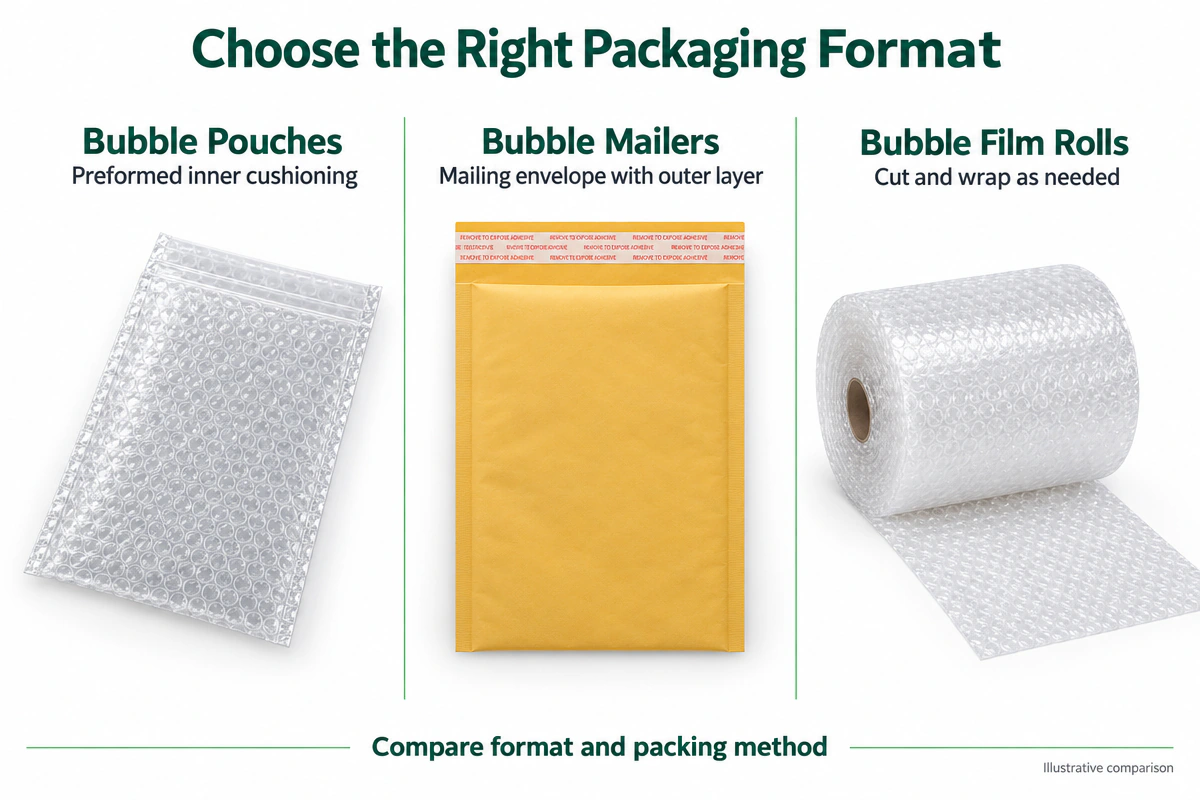
Bubble Pouches vs. Bubble Mailers and Bubble Film Rolls
Product | Main Packaging Format | When to Consider It |
|---|---|---|
Bubble Pouches | Preformed cushioning pouches loaded directly with products | Repeated packing of similarly sized items |
Mailing packs combining an outer material with bubble lining | Products that need an outer mailing pack and suit its protection level | |
Continuous cushioning material cut to the required length | Varied product sizes or flexible wrapping around different areas |
Preformed pouches simplify repeat packing when dimensions are consistent. Rolls offer flexibility when sizes vary. If you need an outer shipping package, assess a suitable mailer or carton separately.
Wholesale Bubble Pouch Orders and Delivery Arrangements
MOQ, Pricing and Lead Times
A quotation normally requires dimensions, material and construction, closure type, quantity and carton packing details. Existing specifications and custom requirements may have different ordering conditions.
Confirm sample preparation, production and transit time separately. Include your destination and preferred arrival date so KENT can assess the overall supply arrangement.
Loose Pouches, Pack Quantities and Roll Requirements
Specify fixed pack quantities, separate cartons for different sizes or required carton labels before quotation.
If your workflow requires connected pouches on a roll, provide the dispensing method and equipment requirements so we can check for a suitable option. Roll supply requires separate confirmation and should not be assumed from the general product name.
Reorders and Specification Consistency
Assign separate product codes to different sizes and retain the approved sample and specification record.
For repeat orders, check material, dimensions, bubble construction, closure and packing quantities. Avoid ordering solely from appearance or a previous product name.
Bubble Pouches FAQs
1. Are Bubble Pouches and Bubble Wrap Bags the Same?
In protective packaging, both terms commonly refer to preformed bubble cushioning pouches. Bag format, closure and bubble orientation can differ, so confirm the actual specification.
2. How Do I Choose the Right Bubble Pouch Size?
Consider product length, width, thickness and protrusions. Check usable internal dimensions and closure space. The item should load without excessive stretching; use physical samples for irregular products.
3. Should I Choose Self-Seal or Open-End Bubble Pouches?
Choose according to your packing process. Open-end options support easy access or retention provided by outer packaging. Self-seal options close the opening with fewer separate taping steps. Repeated opening requires a suitable closure design.
4. What Are Bubble Out Bags?
The term generally describes pouches with raised bubbles facing outward. It identifies bubble orientation but does not, by itself, establish layer count, material composition or protection level.
5. How Are Bubble Pouches Different from Bubble Mailers?
Bubble pouches mainly provide cushioning around a product within a packaging system. Bubble Mailers typically combine an outer material with bubble lining for mailing. Direct-shipping suitability depends on the specific construction and transport requirements.
6. Can Standard Bubble Pouches Protect Electronic Components?
Do not assume suitability for static-sensitive components. Cushioning, anti-static performance and electrostatic shielding are different functions. Check relevant performance information rather than judging by color.
7. Do Bubble Pouches Still Need an Outer Box?
Parcel and freight shipments usually require suitable outer packaging. Fragile, heavy or protruding items may need a carton, dividers or localized support in addition to the pouch.
8. Can I Request Custom Sizes, Thickness and Closures? What Determines MOQ?
Submit your requirements to KENT for review. MOQ, pricing and lead time depend on material, processing requirements, the number of specifications and order quantity. One set of conditions may not apply to every option.
9. How Should I Use Samples to Confirm Packing and Bulk Order Requirements?
Pack your actual product, check the closure and test carton fit. Record the approved specification, tolerances and inspection requirements in the order. Transport protection must be assessed using the complete package, not an empty pouch alone.
10. Are Bubble Pouches Recyclable or Available with Recycled Content?
Recycling depends on the complete material construction, laminated layers, adhesive and labels, as well as local acceptance. For recycled-content requirements, specify the percentage basis and supporting documentation needed. Appearance or a general material name is not sufficient evidence.
Request a Quote for Custom and Wholesale Bubble Pouches
Send the following details to help us assess your requirements:
Product dimensions, weight, photographs and surface-protection needs.
Required pouch dimensions, closure and material.
Initial quantity and expected reorder needs.
Pack quantities, carton labels or roll-format requirements.
Destination and preferred arrival date.
Contact KENT to confirm suitable specifications, sample arrangements and a bulk quotation.


