



What Size Bubble Mailer for Trading Cards?


The bubble mailer size for trading cards depends on the width, length, and thickness of the fully protected pack. A single card in a top loader, a graded slab, and a stack of cards can need different usable space. Add holders and any stiffeners before measuring. Then test loading, movement, and sealing with the mailer you intend to order.
Trading Card Bubble Mailer Size Chart
Choose a bubble mailer size for sports cards from the packing format you actually dispatch. A card count alone leaves out the space taken by holders, backing, and corner protection. For repeat orders, give each format its own reference so your packing team can choose the correct mailer consistently.
The measurement fields below are reserved for sample records. Enter the unit, holder type, mailer reference, and observation date when you complete them. Record each multi-card arrangement separately if its protection or thickness changes.
Pack Type | Packed Length × Width × Thickness | Usable Opening Width | Usable Inside Width × Length | Loading, Closure, and Movement |
|---|---|---|---|---|
Single Card in a Top Loader | ||||
Graded Card Slab | ||||
Multiple Trading Cards |
A sample that loads and closes comfortably is a starting point for selection. You still need to evaluate the complete pack against the handling and protection requirements of the order.
How to Measure Your Packed Cards and Mailer
Measure the Pack After Adding Holders and Stiffeners
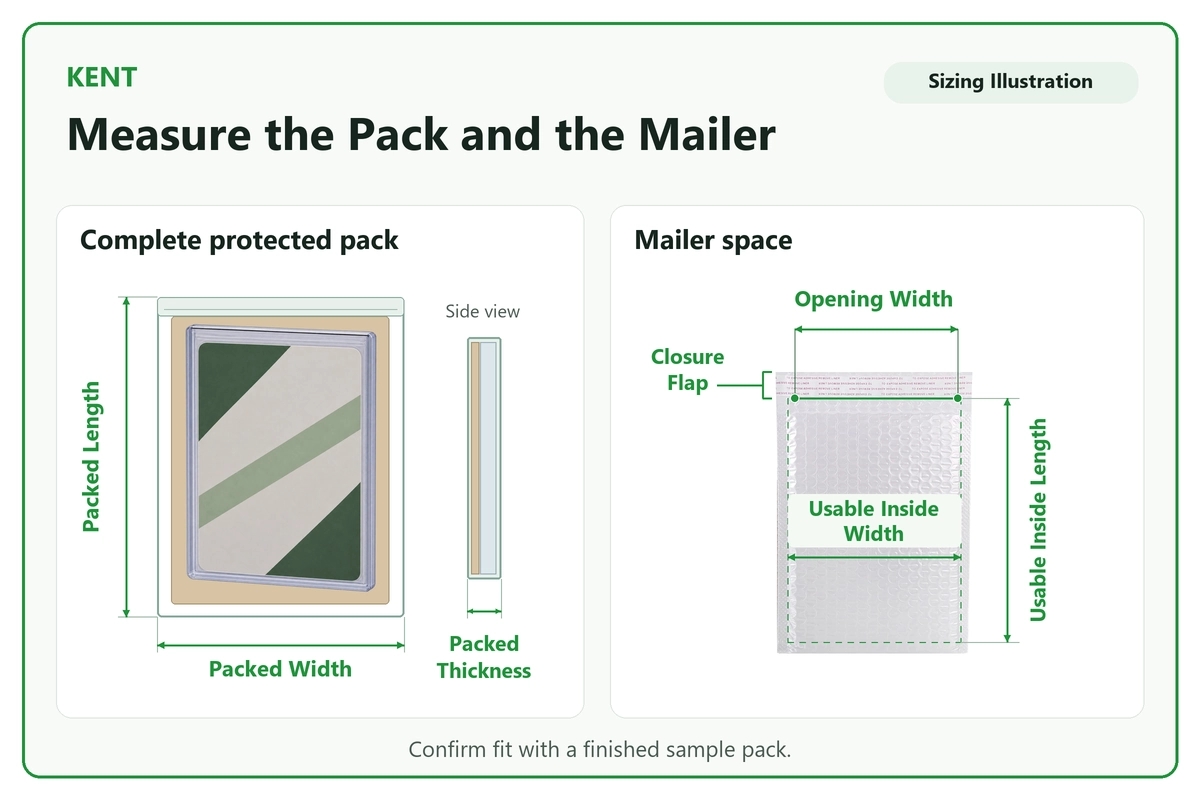
Prepare the card as it will leave your packing station. Include the sleeve, holder, resealable outer sleeve, backing, and any additional protection you plan to use. Measure the assembled pack at its widest, longest, and thickest points.
Keep the same packing arrangement for the comparison. If one sample has extra cardboard or a different holder, record that difference. Otherwise, you may attribute a tight fit to the mailer when the inner pack has changed.
Record which edge enters the bag first. Rotating a rectangular pack changes the width presented to the opening. Use the same orientation during repeated trials, and note whether the packer has to turn or reposition it after insertion. That gives the team a repeatable loading method.
Check the Opening and Usable Inside Dimensions
Confirm whether the supplier's listed size is an outside measurement or usable inside space. Ask how the closure flap is recorded and where the usable length ends. Side seals and the opening can affect whether your pack slides into place.
A flat mailer also has to accommodate thickness when filled. Comparing its width and length with a flat card outline will not establish the fit. Use our bubble mailer size guide to agree on the measurement terms, then verify the chosen sample with your assembled pack.
Bubble Mailer Size for a Single Card in a Top Loader
Pack the Card in a Sleeve and Top Loader
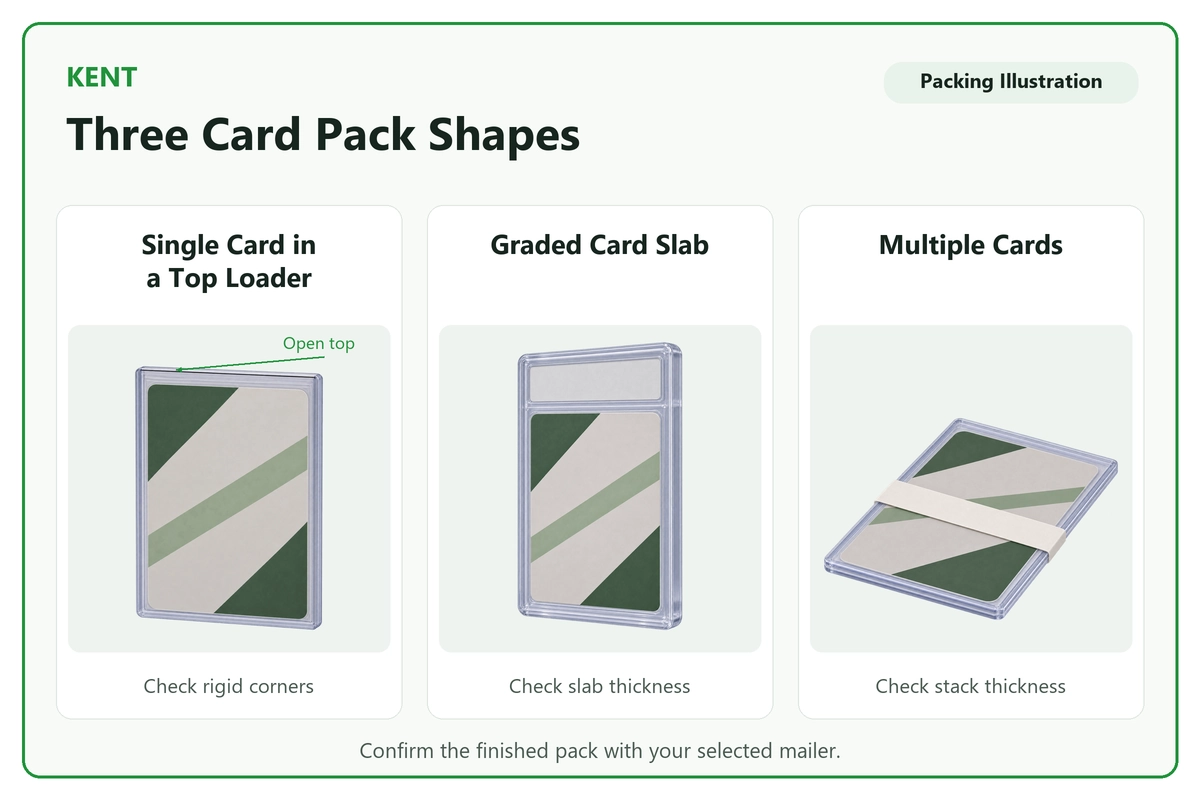
Place the card in its protective sleeve and suitable top loader before choosing the outer mailer. Secure the protected card using the inner packing arrangement you have selected. Keep adhesive away from the card and leave the recipient a practical way to unpack it.
TCGplayer's guidance for sending cards to customers covers sleeves, rigid protection, control of sliding, and an outer mailer or secure envelope. It is a useful reference for the sequence of protection layers. Apply any additional requirements of your selling platform to the order. TCGplayer customer-shipping guidance
If you add a backing board, measure its edges as part of the pack. Keep the holder and backing arrangement consistent when testing another mailer.
Check Whether the Holder Corners Catch at the Opening
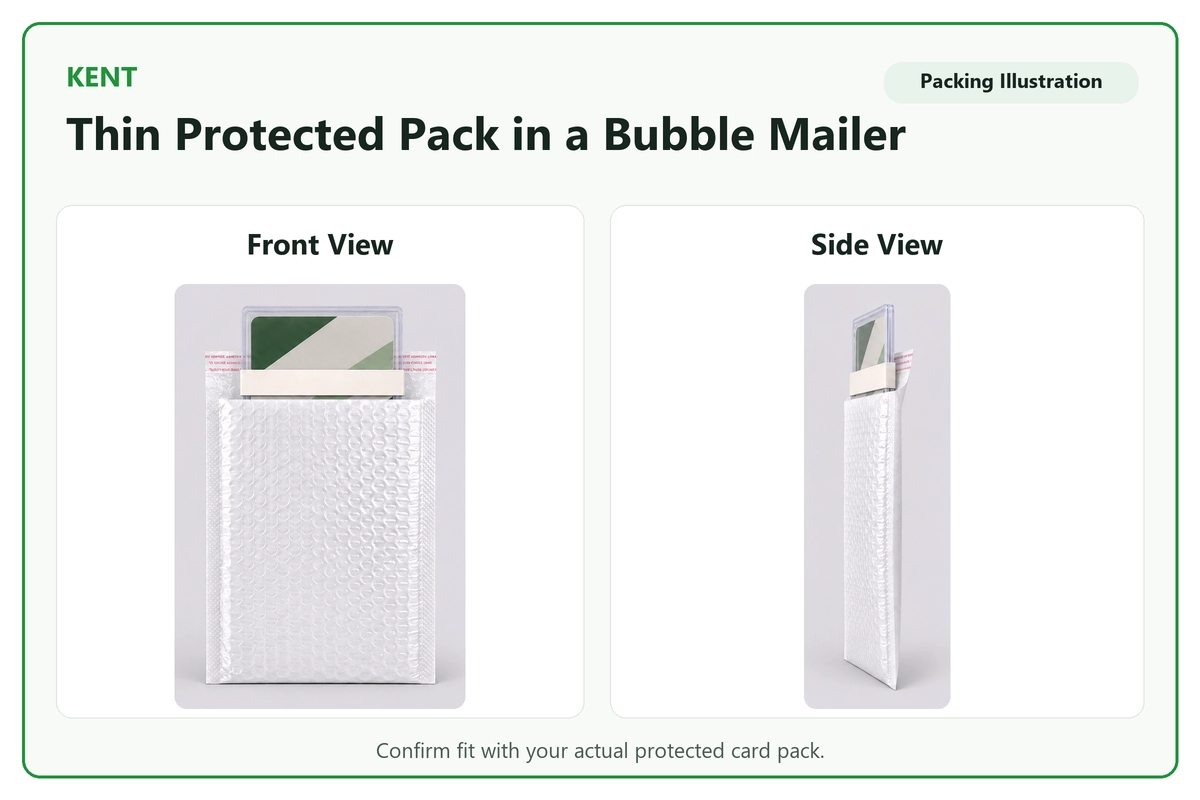
Slide the assembled pack into the bag without forcing the corners past the mouth. Look for a corner catching on the opening or pressing against a side seal. Check whether the pack reaches its intended position before the flap is closed.
If loading requires bending the holder or stretching the mouth, reassess the opening or choose another sample. Extra bag length alone may leave the same narrow opening. The observation you need is whether the actual protected pack can be inserted and removed without strain.
Bubble Mailer Size for a Graded Card Slab
Allow for Slab Thickness and Corner Protection
Measure the actual slab used for the order. Different holder formats can have different dimensions and profiles. Add any protective sleeve, edge protection, or cushioning before measuring the final pack.
Check the area around raised edges and corners when you insert it. A slab that fits a flat outline may still make the filled bag bulge or leave too little room for closure. Record the slab reference with the mailer sample so the result can be repeated.
Check for Slab Movement Inside the Mailer
With the pack closed as intended, gently change its orientation and observe whether the slab moves substantially inside. Check that the inner protection stays in place. If added protection changes the pack's dimensions, repeat the fit check.
Increasing the bag size gives more loading space but can also leave more room for movement. Assess the whole arrangement before settling on a larger size. A fragile case or an order with demanding protection requirements may need rigid outer packaging.
Include any case sleeve you use to protect the slab's appearance. Inspect how it sits around the corners and how you will remove the packed slab. Keep your acceptance notes specific, such as visible movement or a sleeve catching, rather than recording a general impression of quality.
Bubble Mailer Size for Multiple Trading Cards
Compare Bundled Cards With Stacked Individual Holders
Record whether the order uses a grouped pack of sleeved cards, individually protected cards, or a small inner box. These arrangements can have different thicknesses even when they contain the same number of cards.
Keep cards contained inside the chosen inner pack so they do not become a loose pile in the mailer. Check the packed edges as well as the overall thickness. If you use an inner box, include its dimensions and any protection around it in the measurements.
For a mixed order, check whether one holder projects beyond the rest. A narrow stack with one wider holder has a different outline from a uniform stack. Record the widest point and check that the larger holder stays supported when the order is handled.
Check Whether Stack Thickness Pulls on the Seal
Load the intended stack, then close the flap in its normal position. Look for a stack pressing into the closure area, a flap under tension, or parts of the adhesive strip losing contact.
Try representative smaller and larger orders within the group you want one mailer size to cover. If the larger pack strains the closure while the smaller one moves excessively, consider splitting the group into separate packing specifications. Record the configuration for each accepted sample.
When to Use a Rigid Mailer or a Box
Rigid Mailers for Flat Packs That Need Bend Protection
When a flat pack needs more resistance to bending, evaluate a suitable rigid mailer or additional rigid support. Check the holder and any backing together, including how the recipient will open the package.
Changing the outside film or paper alone does not establish the required rigidity. The cushioning, support, and outer packaging all contribute to the complete arrangement. Keep the protection requirement in your specification alongside the size.
Boxes for Packs That Need More Crush Protection
Consider a suitable box when a thick stack, fragile slab case, or inner retail box needs more space and support. Choose the internal protection and restraint with the box so the contents remain in their intended position.
Our bubble mailers vs boxes comparison explains the broader selection factors. For this card order, assess the complete packed sample and the applicable shipping requirements before approving a bulk specification.
How to Choose Mailer Sizes for Repeat Orders
Test Samples With Your Most Common Order Types
Group routine orders by their assembled packing format. Test the smallest and largest pack you expect each chosen mailer to handle. Keep a short record of loading, closure, movement, and any change to the inner protection.
For Poly Bubble Mailers, confirm the film, bubble lining, usable dimensions, and closure on the sample. Retain an approved sample or reference photos with the written specification. That helps you check a later delivery against the configuration you selected.
Write down which holder and backing versions were used. When those components change, review the fit before applying the old packing specification to the new orders. If you retain several mailer sizes at the station, identify which card pack belongs with each one.
What to Include in a Sample Request
Send the packed length, width, and thickness, along with photos of the holder and backing. Explain whether the sample is for a single top loader, a slab, or a multi-card arrangement. Include your expected order quantity and any printing or label-space requirements.
You can request bubble mailer samples to check the fit. Confirm sample availability, charges, and shipping arrangements for your request. Before production, agree on the measurement convention and acceptable variation in the specification.
Test your actual shipping label on a filled sample as well. Check that it lies flat without crossing a seal or wrapping over an edge. For USPS shipments, follow its guidance on placing complete, unfolded labels on the package. USPS package-label guidance
Frequently Asked Questions
Do Sports Cards and Pokémon Cards Need Different Mailer Sizes?
Choose by the fully protected pack, including its holder and backing.
Can You Use a Bubble Mailer for a PSA Grading Submission?
Follow PSA's current guide, which specifies a new shipping box.
Will a Shipping Label Fit on a Small Card Mailer?
Check the loaded bag for a flat area that fits your complete label.
Can You Switch From Poly to Kraft Without Changing the Size?
Retest the packed cards, opening, inside dimensions and closure.
Can You Use a Bubble Mailer for a Sealed Booster Pack?
Add rigid support. Use a box if bending or crushing remains a concern.
Final Thoughts
Choose your trading card mailer around the complete protected pack. Check loading at the mouth, movement inside, and closure around the filled thickness before selecting a repeat-order specification. To request a custom quote, send KENT the packed dimensions, holder type, order quantity, and printing needs. Those details give your sample review a clear starting point.
What Size Bubble Mailer for Trading Cards?

Metallic vs Poly Bubble Mailers for Branded Shipping

